

Choosing a power rack: stability, safety and space
Written by Thibaud Martens, fitness advisor at Fitnessdepot
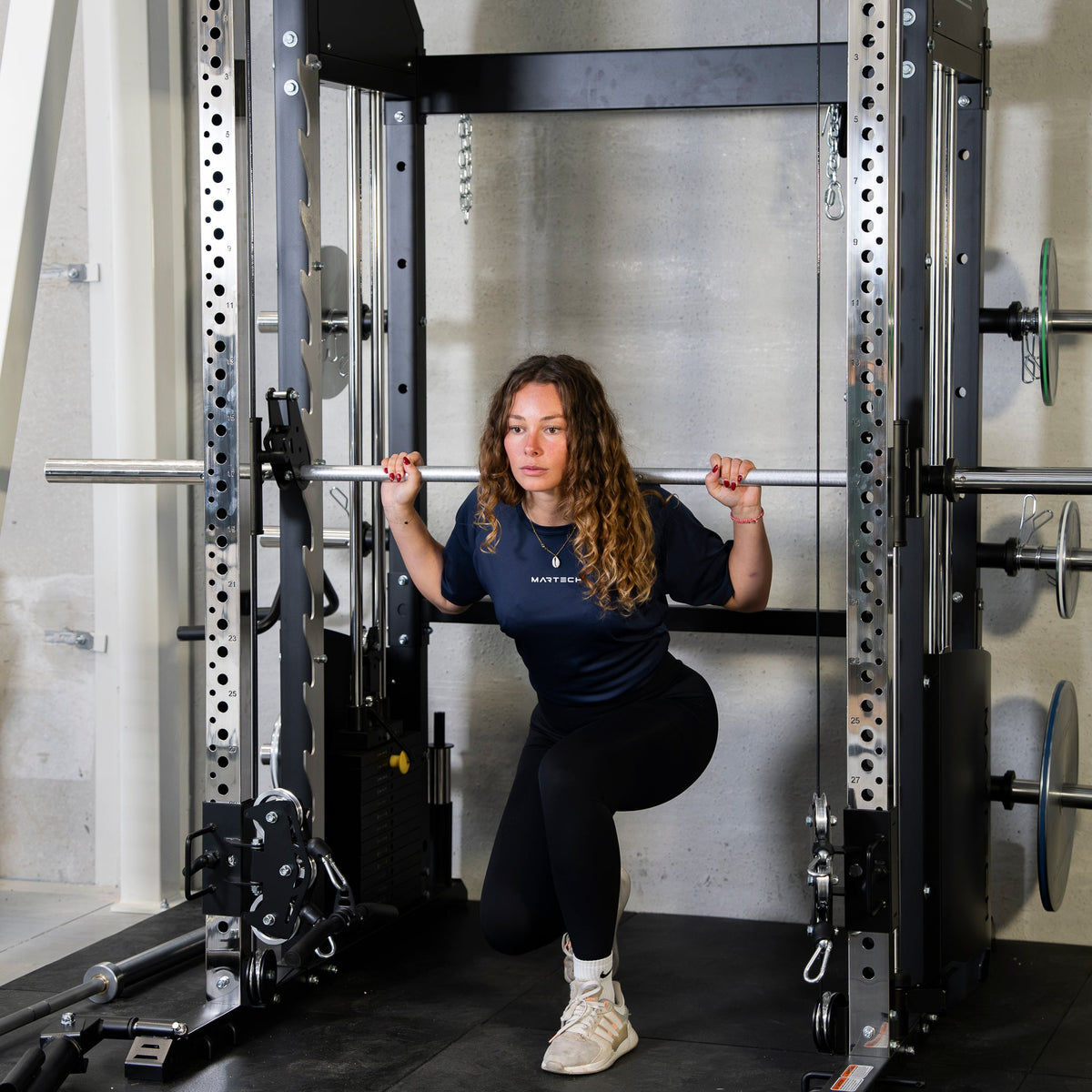
A power rack is the heart of any strength training area. When buying one, you should primarily focus on stability and safety, the dimensions relative to your available space, and how much you can expand the rack in the future. A good rack is a one-time purchase: it will last for years and grow with your training progress.
In our blog about all-in-one racks, you can read why a rack with cables is often the smartest choice. Here, we take a closer look at the rack itself.
Sturdiness: steel, profile, and load capacity
Look at the thickness of the steel and the dimensions of the uprights. A thicker profile means greater stability, especially during heavy squats or when racking the barbell. Also, check the specified maximum load capacity of the J-hooks and spotter arms. This should be well above the weight you are training with.
Safety: do you train alone?
If you train without a workout partner, spotter arms or safety straps are indispensable. They catch the barbell if a repetition fails. Also, choose J-hooks that protect the barbell properly, preventing damage to both your bar and rack.
Height, depth, and your space
- Ceiling height: measure your ceiling and account for pull-ups on top of the rack. Many racks are available in multiple heights.
- Floor space: besides the rack, make sure to account for room to load a 220 cm barbell and to slide a bench in and out.
- Anchoring: a rack that can be secured to the floor or wall offers greater stability during explosive exercises.
Expandability: think about the future
A good rack is modular. With numbered holes and a fixed hole pattern, you can easily add components later: a cable station, a landmine, dip handles, or plate storage. This allows you to start with the basics and expand as your training demands grow.
Standalone rack or all-in-one?
If you have limited space, a rack with integrated cables and weight stacks is often a smarter choice than a separate rack plus a standalone cable station. You save space and combine free weights with cable exercises within just a few square meters.
How much does a power rack cost?
- Half rack: the Martech Heavy Duty 3000 half rack starting from € 745.
- Power cage: the Martech M1 power cage with attachments starting from € 999.
- All-in-one rack with cables: the Martech M8 2-in-1 Precision bundle (€ 3,700), the M8 2-in-1 Twinratio bundle (€ 3,999), or the Martech M10 heavy duty rack with 120 kg stack (€ 5,250).
Prices as displayed on our webshop on October 30, 2026.
What we see in practice
When installing racks, we notice that the ceiling height is the most frequently overlooked factor. Therefore, always measure in advance, and if in doubt, request a free space analysis. We will visit, take measurements, and provide a proposal including a render of your gym.
Frequently Asked Questions
How much space do I need for a power rack?
In addition to the footprint of the rack, account for clearance to load a 220 cm Olympic barbell and use a bench. Also, measure your ceiling height before ordering.
Is a power rack safe to use when training alone?
Yes, provided you use spotter arms or safety straps. These catch the barbell if a repetition fails.
Does a power rack need to be anchored?
It is not always mandatory, but an anchored rack is more stable, especially during pull-ups and explosive exercises.
Do you also install the rack?
Yes, our own team delivers and installs the rack, taking your floor, ceiling and space into account.
Read also: Buying a barbell · Choosing a rubber sports flooring · 1:1 or 2:1 cable ratio?
Discover our power racks and squat racks or test them in the showroom in Ranst.