
Choosing a treadmill: motor, running surface and cushioning explained
Written by Erik Martens, co-founder of Fitnessdepot
When buying a treadmill, it is best to look at four things first: the motor, the size of the running surface, the cushioning, and how often and intensely you plan to run. A treadmill meant for brisk walking twice a week requires something entirely different from a machine used daily for interval runs or by multiple people.
In this buying guide, we outline the most important choices, just as we discuss them with customers in our showroom in Ranst.
How often and how intensely will you run?
Your training habits determine which class of treadmill you need. Therefore, do not start with the price, but with your own usage.
- Walking and light jogging, a few times a week: a solid home treadmill is sufficient.
- Regular running and interval training: choose a stronger motor, a larger running surface, and a higher top speed.
- Shared use (family, corporate gym, hotel, practice): choose a semi-professional or professional machine built for many operating hours per day.
The motor: look at the continuous power
For a treadmill, the continuous power (often in CHP) is more important than the peak power. This is what the motor can deliver over a long period without overheating. A stronger motor runs more smoothly, wears out less quickly, and maintains speed better with every footstrike, especially for heavier runners or at higher speeds.
The running surface: large enough for your stride
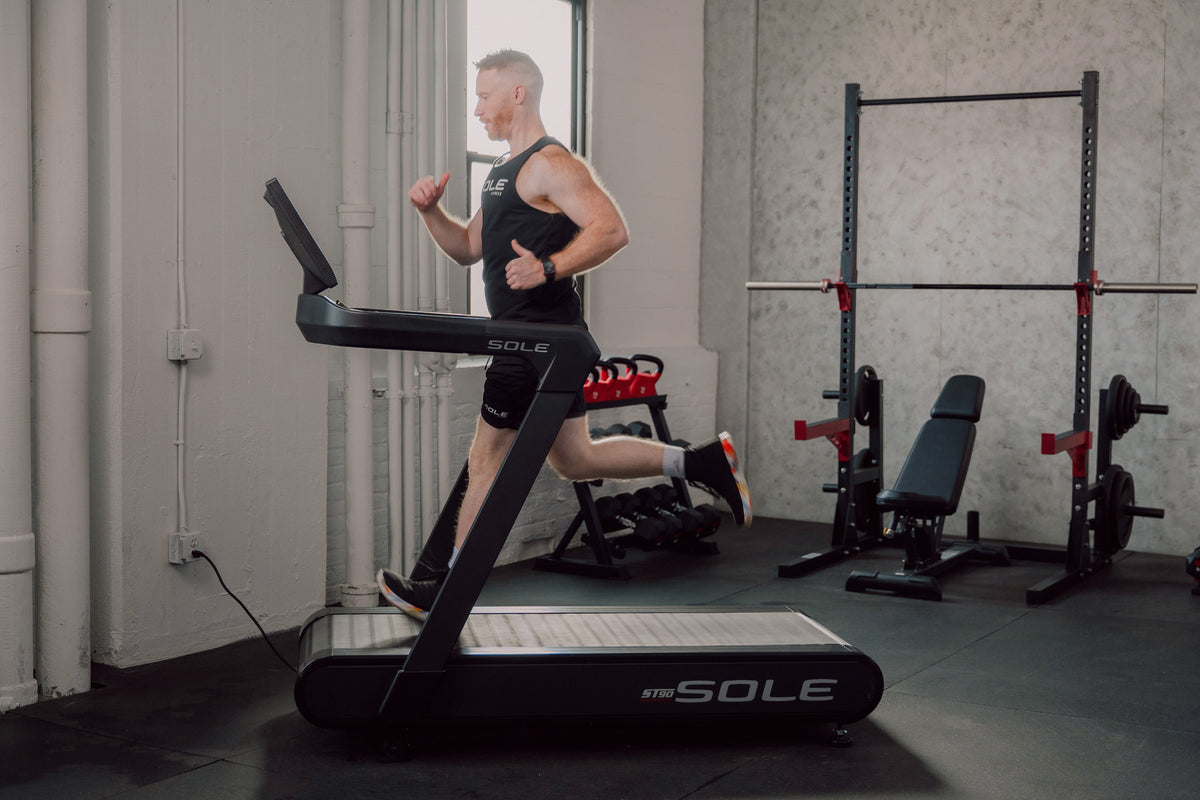
The running surface must match your stride length. Runners need a longer and wider running surface than walkers. A running surface that is too short feels unsettling and forces you to shorten your stride. If you are tall or run fast, definitely opt for a spacious running surface.
Cushioning: comfort and protection
Good cushioning absorbs the impact and protects your joints. At the same time, a treadmill should not feel too soft, as that causes you to lose energy with every stride. You will only truly feel the difference when you run on it. Therefore, we recommend testing multiple treadmills side by side before making a choice.
Incline, speed and programs
- Incline function: walking or running uphill makes your workout more challenging without requiring you to move faster.
- Top speed: for interval training, you want a sufficient margin above your normal running speed.
- Programs and apps: useful for motivation, but less important than the motor, running deck, and cushioning.
Space, ceiling height, and flooring
Measure your space before ordering. In addition to the treadmill, make sure to allow for free space at the back and sides so you can step off safely. Also pay attention to the ceiling height: you stand a few centimeters higher on the treadmill, and even higher when using an incline. A rubber sports floor underneath your treadmill protects the floor and absorbs sound and vibrations.
How much does a good treadmill cost?
You can buy a home treadmill from us starting at € 1,495. How much you should spend depends on how intensively you run:
- Starting at € 1,495: walking and jogging, e.g. the DKN Airun-Z 2.0 (€ 1,495) or the Sole F63 (€ 1,595). If you are preparing for a marathon, consider a slightly heavier model from the next category.
- Approximately € 2,000 to € 3,500: regular running, e.g. the DKN Roadrun i 2.0 (€ 1,999), the Sole F80 (€ 2,595) or the Sole F85 (€ 3,095).
- Starting at approx. € 4,500: intensive or shared use, e.g. the DKN ProRun 2.0 (€ 4,495) or the Spirit CT800+ (€ 4,895). For fitness centers, prices can go up to € 12,995.
Prices as displayed on our webshop on October 30, 2026.
What we see in practice
During delivery and installation, we often see that people underestimate their usage: those who start out walking often end up jogging after a few months. Therefore, it is better to choose a treadmill that goes a step beyond what you are doing today. Replacing a treadmill costs more than choosing the right one straight away.
Frequently Asked Questions
Which treadmill is suitable for home use?
For home use, choose a treadmill based on your usage: walking and light jogging require a reliable home treadmill, while regular running requires a stronger motor and a larger running surface. If in doubt, test different models in our showroom.
Is a foldable treadmill a good idea?
A foldable treadmill saves space, but is often less sturdy than a fixed treadmill. If you run intensively or frequently, it is better to choose a non-foldable model.
Do I need a mat or a sports floor under my treadmill?
Yes, we recommend that. A rubber mat or sports floor protects your floor, absorbs vibrations, and reduces noise transmission.
Can I test treadmills before buying?
Yes, in our showroom in Ranst you can try out various treadmills and get advice from the people who also deliver and install them.
Also read: Choosing a rubber sports floor · Buying a rowing machine · Setting up your home gym
Ready to choose? View our treadmills or plan a visit to the showroom to test them yourself.